The Pomodoro Technique: a promise to stop, not to work
It is 2:37 in the afternoon. You sat down at 1:30 to finish one report. Since then you have opened eleven tabs, replied to two messages that could have waited until Thursday, and read most of a thread about octopus cognition.
The report has one paragraph in it. You wrote that paragraph at 1:34.
The problem is not that you cannot concentrate. You concentrated on the octopus thread for nineteen minutes without blinking. The problem is that nothing was holding the shape of the afternoon, so the afternoon took whatever shape was on offer.
The rule underneath everything: a pomodoro is a promise to stop
Most people meet this technique as a rule about working: focus for twenty-five minutes. That framing is why it fails for them by Thursday.
The useful framing is the opposite. When you set the timer, you are not promising to work well, or to work hard, or to enjoy it. You are promising that in twenty-five minutes you get to leave. That is a small enough thing to agree to when you are avoiding something, and it is the whole mechanism.
Starting is the expensive part of any task. A bounded commitment makes it cheap. Everything else in this article is detail.
Where the tomato came from
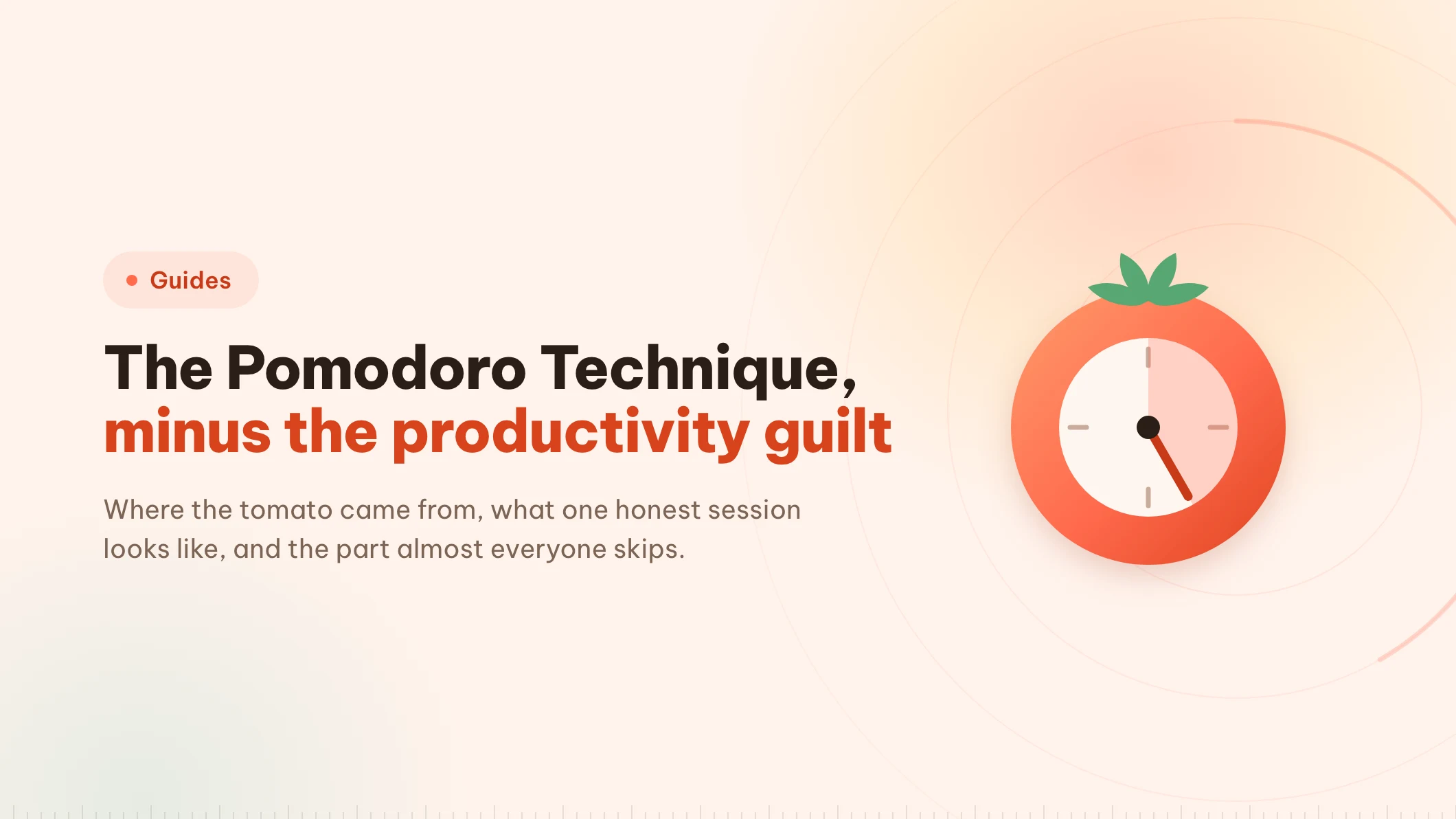
In the late 1980s, an Italian university student named Francesco Cirillo was having the afternoon described above, repeatedly. He picked up the wind-up kitchen timer from his kitchen — shaped like a tomato, pomodoro in Italian — and made a deal with himself to work until it rang.
He kept refining it and published the method; it has been in circulation ever since. The recipe is short enough to fit in a sentence: work for 25 minutes on one thing, break for 5, and after four rounds take 15 to 30 minutes off.
That is the entire technique. No tagging system, no morning routine, no spreadsheet.
One session, start to finish
The steps matter less than the two rules hidden inside them, so both are marked.
- Write the task in one sentence. “Draft the intro email to the supplier”, not “email”. If your sentence needs the word and, you have written down two tasks and you should pick one.
- Set 25 minutes and put the phone out of reach. Across the room is better than face-down on the desk, which is better than in your hand. Distance buys you seconds, and seconds are what this is made of.
- Keep a scrap of paper next to you. Every stray thought goes on it. Reply to Minh. Cat food. Check if the invoice went out. Writing it takes three seconds and the urge to act on it drops off immediately, because the thought’s real demand was to not be forgotten.
- When it rings, stop — even if it is going well. This is the rule people break first and regret slowest. Stopping mid-flow feels wasteful. It is what makes the next session easy to start, because you begin with a thread already in your hand instead of a blank page.
- Take the five minutes away from a screen. Stand up. Refill the glass. Look at something more than two metres away. A scroll break rests your legs and nothing else.
- After the fourth round, take a real 15 to 30 minutes. Lunch counts. A walk counts. A fifth pomodoro does not count.
What do I do about interruptions?
Cirillo split them in two, and the split is worth keeping.
Your own brain offering a fascinating detour goes on the paper. All of them, every time.
Other people get the same three moves in order: tell them you are mid-something, agree a time (“come back at twenty past?”), then actually go back to them when the session ends. Most requests survive a twenty-minute wait. The ones that cannot wait are allowed to break the session — you drop it, deal with the thing, and start a fresh one afterwards. Nothing is being scored.
Why a kitchen timer beats willpower
Three reasons, in descending order of how sure anyone can be about them.
It shrinks the ask. “Write the report” is a commitment of unknown size, and your brain prices unknown commitments high. “Work on the report for 25 minutes” has a visible end. You are not negotiating with a task any more, you are agreeing to a slot.
The break is doing work too. Performance on long, monotonous tasks tends to drift downward the longer you go without a pause — psychologists call it the vigilance decrement, and it has been measured since the 1940s. The effect is clearest for monotonous work and blurrier for varied knowledge work, so treat regular breaks as sensible maintenance rather than a law.
Finished sessions are countable. “I worked all day” is a feeling, and on a bad day it is a lie. “Four sessions” is a fact, and a fortnight of facts shows you patterns about your own days that no advice can guess for you.
One thing this does not do: create focus out of nothing. It builds a shape where focusing is the default and drifting takes a small deliberate effort, instead of the reverse.
Fifteen, twenty-five or fifty
The 25/5 rhythm is a starting default, not a finding about human attention. Three settings cover most people:
| Length | Break | Use it when |
|---|---|---|
| 15 min | 3 min | The task frightens you, or it is a bad day, or it is week one |
| 25 min | 5 min | Mixed days, studying, admin, most things |
| 50 min | 10 min | You are already warmed up and the work needs a run-up |
One rule of thumb ties them together: if starting feels hard, shorten the interval. Not lengthen it. People who are struggling tend to reach for a longer session as a show of seriousness, which raises the price of starting at the exact moment they cannot afford it.
Whichever you pick, keep the breaks the length you said. The breaks are not the reward for the work; they are the reason the next session starts.
When this is the wrong tool
Pomodoro is good at shapeless days and medium-sized tasks. It is worse at two things.
Long creative dives. If it takes you twenty minutes to load a problem into your head — most programming, most writing, most design — a bell at minute 25 arrives roughly when you finally became useful. Either move to 50 or 90 minute blocks, or look at Flowtime, which drops the fixed bell entirely and lets you note when you started and rest when you actually flag.
Days that are already fragmented. If your calendar is meetings with 18-minute gaps, the technique will mostly measure the gaps. Fix the calendar first.
And if you have ADHD, or suspect your attention runs on a different clock: external timers help many people and 25 minutes suits very few of them out of the box. Some do best at 10, some at 45. That is not a failure to follow the method, it is the method working as intended — the number was always meant to be adjusted.
Your first session, today
Pick a task small enough to be slightly embarrassing. Write it in one sentence. Put the phone across the room. Set 15 minutes, not 25 — momentum first.
Go. When it rings, stand up.
Then decide freely whether today is a one-session day or a six-session day. The count is information, not a grade.
Fomodo has Pomodoro as one of four modes, and can shield your distracting apps for the length of a session so the timer and the temptation are not one tap apart. Worth saying plainly: the shield only covers apps on this iPhone. It has no opinion about the laptop open next to you, and it cannot make you care about the report.
What it does do is keep the count without being asked, and when the fourth session ends the ring closes with a small sound that is honestly a bit silly. People start working for that sound. We are not going to pretend otherwise.
The number you are looking for is not twenty-five. It is one — one session, today, on a task you can name in a sentence.