Ultradian rhythm: what the 90-minute block rests on
It is 10:15 on a Tuesday and the hard thing is going well. Sentences arrive in the right order. You are ahead.
At 11:40 you read the same paragraph three times, decide you are hungry, and end up standing in front of the open fridge holding a jar of olives you do not want.
Nothing happened in between. No meeting, no bad news, no second coffee.
Something changed gear on a schedule you did not set and cannot see. The trouble is that the internet has a very confident answer about what that schedule is, and the confidence is not earned.
The rule: a borrowed rhythm is a guess, your own Tuesday is data
Every article about ultradian rhythms hands you a number. Ninety minutes on, twenty off, repeat.
The number is a reasonable default and a poor law. It came out of sleep research, it was extended to waking life as a hypothesis, and the extension has never been nailed down the way the sleep half has.
So the useful move is not to adopt someone’s cycle. It is to spend one week finding out when you are actually good, and then move the hardest thing there.
What Kleitman actually found
Nathaniel Kleitman spent his career at the University of Chicago taking sleep seriously before that was a normal thing to do. With Eugene Aserinsky he identified rapid eye movement sleep, published in Science in 1953.
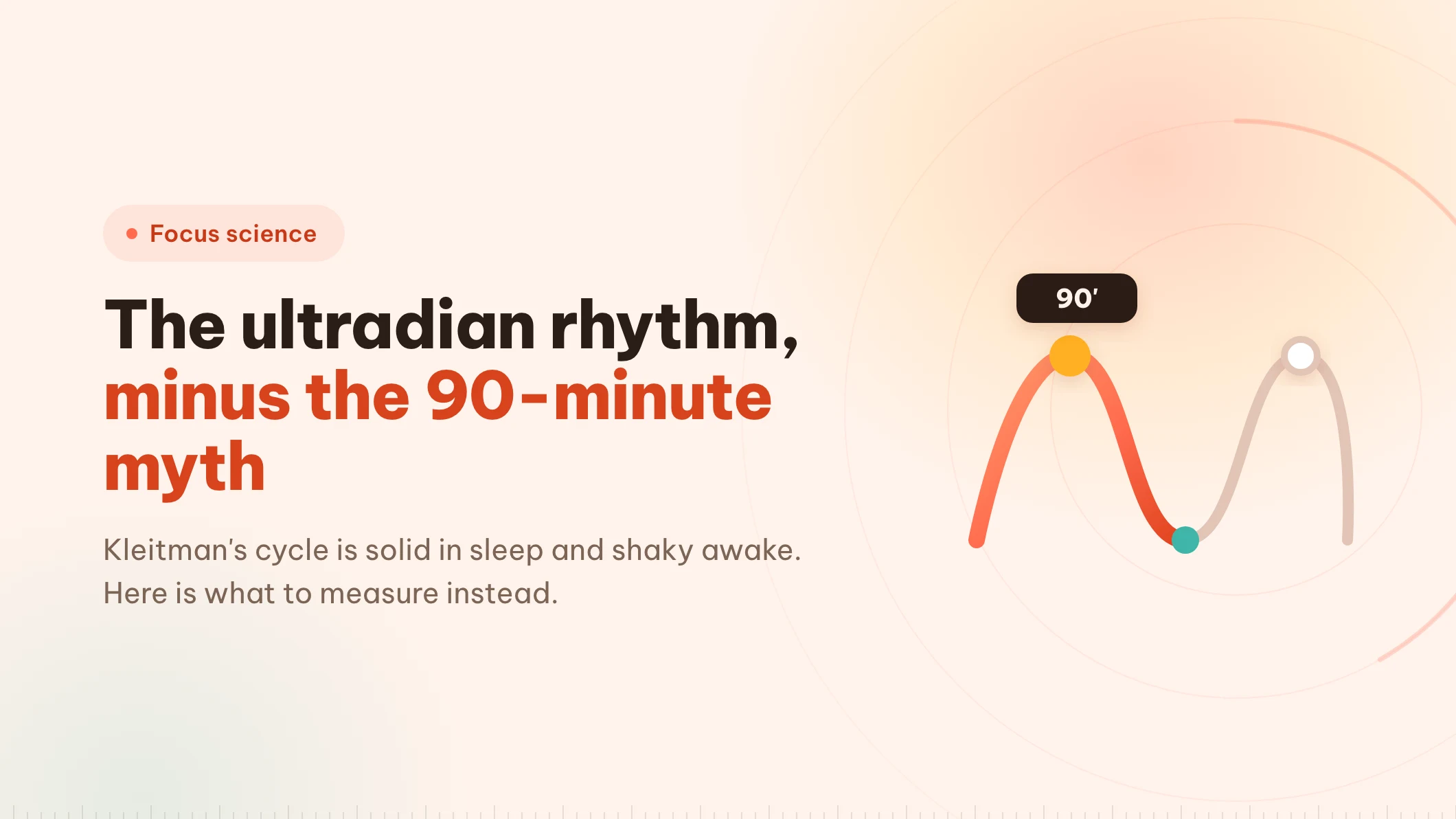
Watching sleep move through its stages in a repeating loop, he proposed something bigger: a Basic Rest–Activity Cycle, an oscillation of roughly 90 minutes that runs all night and, he suggested, keeps running through the day. He set the idea out around 1960 and returned to it in a 1982 paper in the journal Sleep with the flat title “Basic rest-activity cycle — 22 years later.”
The sleep half held up. Sleep does cycle at roughly 90 minutes, though it is no metronome — early cycles carry more deep sleep, later ones more REM, and the length varies between people and across the night.
The waking half was the hypothesis. It stayed one.
Why “90-minute waking cycles” is shakier than it sounds
People went looking. Peretz Lavie and colleagues ran ultrashort sleep–wake schedules through the 1970s and 80s and did find rhythmic variation in sleepiness across the day.
But the results across studies have not lined up. Period lengths differ between individuals and between what you measure, some studies find nothing, and whatever signal is there gets swamped by sleep debt, caffeine, light, meals and your calendar.
The tidy prescription — work 90, rest 20 — is not the output of a controlled trial of 90-minute work blocks. There is no such trial to point at. The popular version traces largely to business books of the early 2000s, which extrapolated from sleep physiology into a schedule.
The most-cited piece of support is a 1993 study of violinists by Ericsson, Krampe and Tesch-Römer in Psychological Review, which is not a study of ultradian rhythms at all. It reports that the strongest players practised in a few separate bouts with real rest between them, and slept more, including naps. Diary and interview data from one conservatory, with later replication attempts finding weaker effects. It tells you something about rest, not something about ninety.
So is the 90-minute number wrong?
Not wrong. Unproven as a law, and perfectly serviceable as a starting default.
The distinction changes what you do when it does not fit you. If it is physiology, a bad fit means something is broken in you. If it is a starting number, a bad fit means you change the number and get on with it.
Map your week: five days, fifteen entries
Three checks a day, five days. Six is too much bookkeeping and one tells you nothing.
Rate the hour that just ended, not the second you are in. Use H, M or L.
| Mon | Tue | Wed | Thu | Fri | |
|---|---|---|---|---|---|
| 11:00 | H | H | M | H | M |
| 15:00 | L | L | L | M | L |
| 20:00 | M | H | M | L | — |
Add three words when something obviously explains a low: bad night, skipped lunch, three meetings.
Five days shows you a shape. Ten is better. Twenty is a hobby, and you should stop before then.
You are not looking for a 90-minute wave, and you will not find one. You are looking for three facts: where the reliable high sits, where the reliable trough sits, and whether your evening comes back.
Most people find one clear peak, one clear trough, and an evening that either returns or does not. The early-afternoon dip is real and turns up in circadian research even when people skip lunch, so stop blaming the sandwich.
Put the hardest thing in the peak, then defend it
The peak is usually two to three hours wide, not a whole morning.
The move is a swap, not an addition. Whatever currently occupies your peak — email, the standup, “warming up” — gets pushed out, and the one piece of work that needs your best head goes in.
It costs nothing except an argument about meeting times, which is a scheduling problem before it is a discipline problem, the same argument deep work always turns out to be about.
Defend it with two rules and no more: nothing on the calendar in that window, and the phone in another room.
The 90+20 shape, as a default rather than a law
Three shapes cover almost everyone.
| Block | Break | Use it for |
|---|---|---|
| 25 + 5 | 5 min | Admin, revision, bad days, anything you are avoiding |
| 50 + 10 | 10 min | Most real work, most days |
| 90 + 20 | 20 min | Work with a long load-in: code, design, drafting, proofs |
There is an honest argument for the long block, and it has nothing to do with Kleitman. If it takes you 20 minutes to load a problem into your head, a 90-minute block buys you 70 useful minutes and a 50-minute block buys you 30. That is arithmetic, not physiology.
The break has to be an actual break. Twenty minutes on a feed is not rest, it is an unpaid shift with worse lighting.
And if you cannot predict when you will flag — which is most people, most weeks — the fixed block is the wrong instrument. Note when you started and stop when you fade, which is what Flowtime is for, or shorten the block until starting is cheap again, which is the argument behind twenty-five minutes.
Where caffeine and naps really sit
Caffeine does not create energy. It blocks adenosine, the molecule whose build-up you experience as sleep pressure, so the pressure is masked rather than cleared. It is all still waiting when the caffeine leaves.
Half-life in most healthy adults runs around five hours, with wide variation by genetics and by what else you take. A 16:00 coffee is meaningfully still in you at 21:00. Drake and colleagues (2013, Journal of Clinical Sleep Medicine) gave people 400 mg six hours before bed and still measured disturbed sleep — twelve participants and one fixed dose, so read it as a caution rather than a rule.
Use caffeine to defend a peak, not to manufacture one at 16:30.
Naps pull the other lever: they actually reduce the pressure. The catch is depth, because past a certain point you wake up worse than you went in. Brooks and Lack (2006, Sleep) compared 5, 10, 20 and 30-minute naps in sleep-restricted young adults and the 10-minute nap came out best for alertness. Small lab study, one population, so take the direction rather than the number: short, and taken before the afternoon is already ruined.
When this is the wrong frame entirely
If your sleep is irregular, you are not measuring a rhythm. Shift work, a new baby, a 02:00 bedtime three nights a week — the chart will just draw your sleep debt. Fix the sleep, then measure.
If your calendar is already shredded, mapping peaks tells you about a peak you cannot use. Move two meetings first.
If the tracking becomes the project, stop at five days. The whole exercise exists to produce one decision, not a dataset.
And if you are tired in a way that is new, constant, and does not respond to a good night — that is a doctor’s question, not a timer’s. No rhythm chart is going to catch it.
What to do on Monday
Set three phone alarms: 11:00, 15:00, 20:00. When one goes, write one letter in a note. That is the entire commitment.
On Saturday, look at the column that has the most H in it. Next week, put your hardest hour there and move whatever was in the way.
Fomodo runs Ultradian Standard and Ultradian Extended alongside Pomodoro and Deep Work, so a long block with a real break is one tap rather than a mental arithmetic problem. The limit is worth stating plainly: the app has no idea what your energy is doing. No sensors, no heart rate, no clever inference — it runs the shape you picked, whether or not that was the right shape today.
What it does keep is the record. After a fortnight the heatmap shows when you actually worked, which for most people is not when they had planned to, and that gap is more useful than any number a book can hand you.
Your peak is already in your week. You have just never written it down.